Erdogan and Stoker Strengthen Strategic Partnership Between Ankara and Vienna on Economic and Political Dimensions
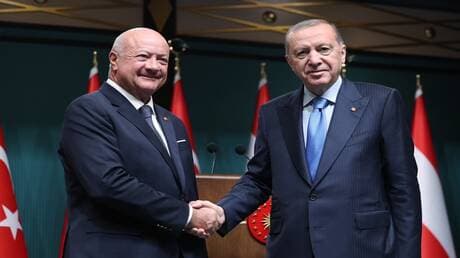
In a framework aimed at strengthening diplomatic ties between European capitals and the Turkish capital, President Recep Tayyip Erdogan hosted Austrian Chancellor Christian Stocker at the Presidential Complex in Ankara, where official welcoming ceremonies were held reflecting the depth of bilateral relations. Both sides focused during the exclusive meeting on meeting shared expectations for the future of bilateral cooperation, while highlighting the pivotal role played by Ankara in the regional and international arena in a distinctive manner.
Prospects for Economic and Trade Cooperation
The Turkish leader affirmed that updating the customs union with the European bloc and managing the visa liberalization dialogue represent strategic steps that serve the common interests of both parties in a balanced and sustainable manner. Erdogan pointed out promising investment opportunities in vital sectors such as sustainable energy, rare minerals, technological innovations, advanced defense industries, and maritime and land transport.
The Turkish president stated that the positive momentum in political relations directly impacts economic growth, expecting to surpass the symbolic threshold of five billion dollars in trade value this year. The volume of trade between the two countries reached approximately $4.5 billion in 2025, enhancing the possibility of achieving shared strategic cooperation to better support the Middle Corridor.
Regional Issues and International Security
The two leaders addressed ways to ensure stability in the Balkans region, emphasizing the importance of maintaining regional security as a fundamental pillar for long-term cooperation between the two states. They also discussed recent developments in the Middle East, focusing on the necessity of supporting a two-state solution as the only roadmap to achieving comprehensive and lasting peace in the turbulent region.
Erdogan expressed Ankara's appreciation for Austria's contribution to Syria's reconstruction efforts, affirming that preserving the territorial integrity of Syria remains an unwavering strategic goal of Turkish foreign policy. He also reiterated the importance of continuing the flow of humanitarian aid to the Gaza Strip, considering it an urgent humanitarian issue that gains top priority under current difficult humanitarian circumstances.
For his part, Austrian Chancellor Christian Stocker praised the mediating role played by Turkey, saying: "When we follow Middle East issues, we see that Turkey's voice has weight and significant influence." Stocker also appreciated Turkey's efforts to end the war in Ukraine, considering Ankara an essential partner in Europe's pursuit of general geopolitical security and stability.
Related Articles

Moscow Rejects Temporary Ceasefire, Vows to Continue Fighting in Ukraine
Russian defense officials rejected ceasefire proposals in Ukraine, stating peace cannot be achieved through temporary stops. They announced strikes on fuel depots in Chornomorsk and the destruction of a weapons-carrying ship near Odesa. A Russian senator urged the West against escalation, while Moscow insists on continuing the fight.

Moscow Claims Foiled Drone Assault and Strikes on Ukrainian Ports
Russia announced the interception of 453 drones targeting wide areas including Moscow and several provinces, while launching counter-strikes on the port of Chernomorsk and a cargo ship in the Black Sea. This escalation reflects the continuation of daily attacks by Ukraine and the Russian military's response, which seeks to expand its ground operations to prevent direct targeting of Russian territory using advanced Western weapons.

Lavrov Threatens British Retaliation if Russian Soil is Struck
Russian Foreign Minister Sergei Lavrov warned of severe consequences if British forces participate in strikes on Russian soil, deeming it direct war involvement. The remarks follow reports of Ukraine receiving long-range drones. The article highlights the shift in Western support and the expanding European confrontation, set against the backdrop of ongoing tensions between Moscow and the West regarding military intervention limits.